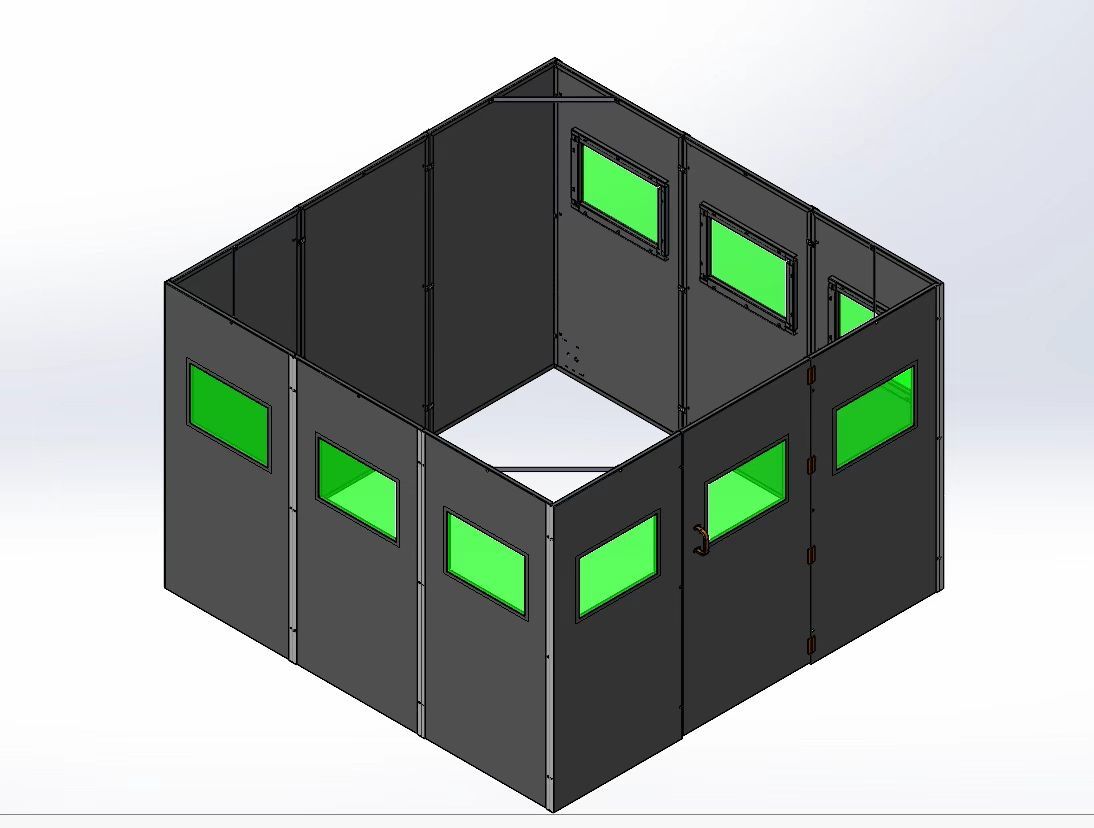
Material selection, interlock design, and compliance testing — what you need to know before building a laser enclosure.
A laser safety enclosure isn't just a box around a laser. It's a engineered system that must meet specific standards while remaining practical for production use.
Material Selection — The enclosure walls must withstand the laser's full power for a defined duration (typically 30–60 seconds) without burn-through. For fiber lasers up to 6kW, we typically specify 1.5mm mild steel panels. Higher-power applications may require specialized laser-blocking polycarbonate for viewing windows.
Interlock Design — Every access point needs an interlock that kills the laser beam before the door/panel can open. Use redundant interlocks (two independent circuits) for Class 4 laser systems. The interlock response time must be faster than the door opening speed.
Ventilation — Laser processing generates fumes. The enclosure needs extraction points positioned to capture fumes at the source without creating turbulence that affects beam quality. Negative pressure inside the enclosure prevents fume leakage.
Access & Ergonomics — Operators need to load and unload parts efficiently. Design the enclosure around the workflow, not the other way around. We use motion studies to optimize door placement, load height, and sight lines.
Compliance Testing — Before the enclosure goes live, it needs to be tested per IEC 60825-4. This includes power meter measurements at every seam, interlock response time verification, and a walk-around inspection with a beam detector.
We've designed enclosures for tube lasers, flat-bed cutting systems, and welding lasers. Each application has unique constraints, but the fundamental safety principles are the same. Reach out if you need a design review or a custom enclosure engineered from scratch.